A Soulful Nexus
Akropolis Reed Quintet
Derrick Skye
Release date: September 25, 2026 on Bright Shiny Things
Press: Paula Mlyn, A440 Arts paula@a440arts.com
Following a 2025 GRAMMY® win for Strands by Pascal Le Boeuf, the Akropolis Reed Quintet presents A Soulful Nexus by Derrick Skye. The quintet’s 7th release is an album-length transcultural work shaped by deep listening across musical traditions. Persian classical music, Balkan vocal lines, and electronic dance rhythms intersect through intricate ornamentation and microtonal color. Across five movements, a kaleidoscope of geographies and sonic languages—rhythmic, polyphonic, groove-based, and meditative—interweave to reveal a shared purpose: music that listens to the world.
“Too often, transcultural work is framed as ‘fusion.’ We’re not fusing—we’re building a world where musical languages coexist without hierarchy.” ~Derrick Skye
Heart Sutra Mantra
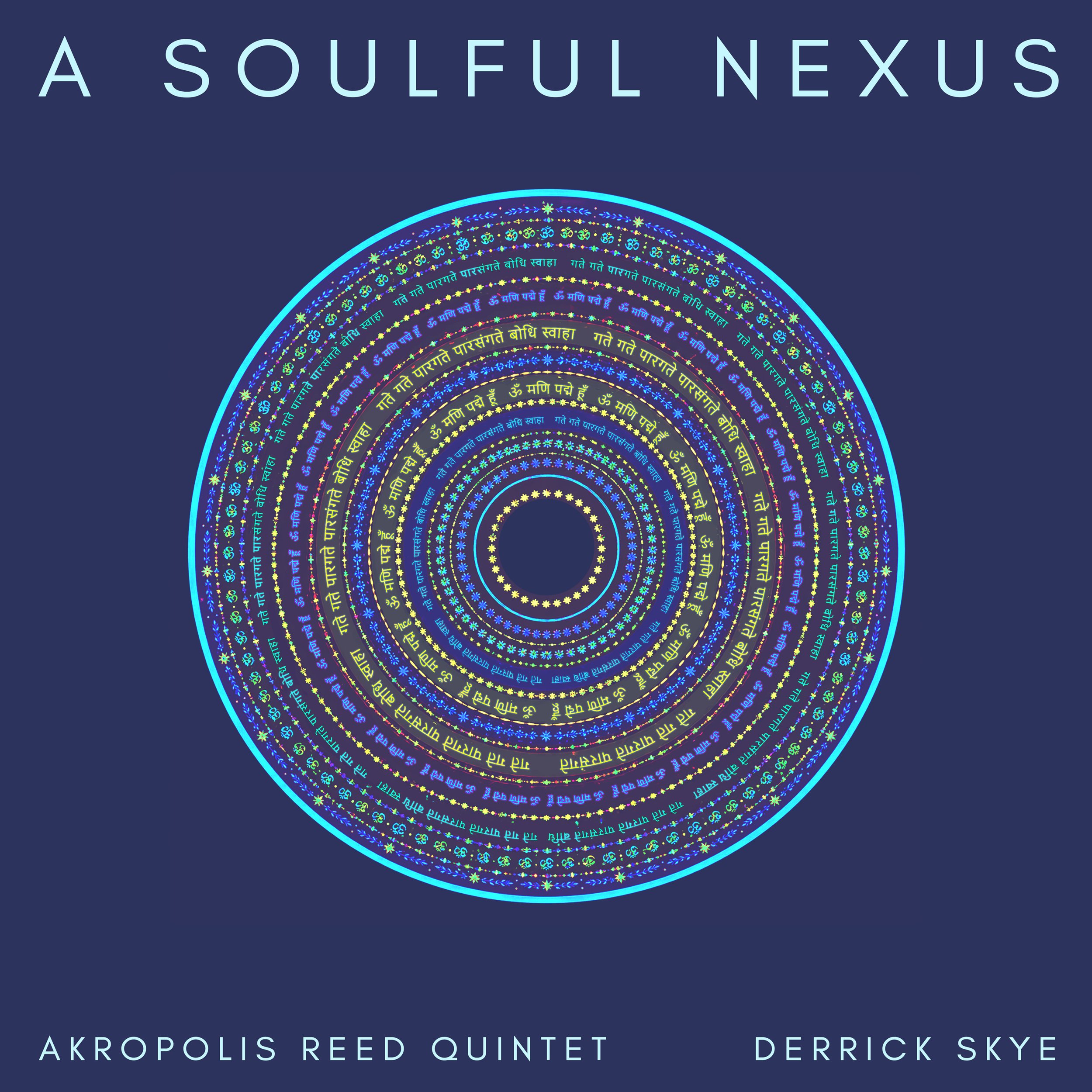
गते गते पारगते पारसंगते बोधि स्वाहा
The Sanskrit text on the cover is drawn from two mantras central to Mahayana and Vajrayana Buddhism, alternating ring by ring. The Heart Sutra mantra - Gate Gate Pāragate Pārasaṃgate Bodhi Svāhā - is a mantra of crossing over to the far shore. Alongside it sits Om Mani Padme Hum, the mantra of compassion. Its central image - the jewel held within the lotus - speaks of compassion held within wisdom, two things made whole by their union. The lotus itself, growing from mud yet blooming unstained, also echoes the suite's recurring sense that what first sounds like imperfection can reveal itself as an aspect of a different kind of perfection. Their alternating concentric arrangement reflects the spirit of Movement 3 (Mantras), where small phrases circle independently across the five voices, returning as anchors - transformation and recurrence held in balance.
Om Mani Padme Hum
ॐ मणि पद्मे हूँ

Derrick Skye is an acclaimed Los Angeles-based composer and musician known for his transcultural approach to music, integrating various musical practices from cultures around the world into his work with Western classical communities. The Los Angeles Times has described his music as “something to savor” and “enormous fun to listen to,” while The Times (London) has praised Skye’s music as “deliciously head-spinning.”
About the album
Program notes written by Derrick Skye in collaboration with Dr. Kim Nguyen Tran
A Soulful Nexus is a five movement reed quintet tracing the pathways of a musical language shaped by deep study and genuine love of several of the world’s melodic traditions. At the center of that language is ornamentation: the way a melody breathes around a note rather than simply landing on it. For me, that impulse, which I first heard in the ornamentation of solo sung Gospel music and recognized again in Persian classical music, Indian classical music, and Eastern European vocal traditions, is the connective tissue of this entire work.
From Persian classical music, the suite draws on Dastgāh-e Mâhur and Dastgāh-e Râstpanjgâh as its primary modal worlds, with Morakab-Navazi, the practice of weaving between modal areas, guiding the music through Gushé Shekaste and Darâmad Dastgāh-e Mâhur. Central to the harmonic language is the E koron, a pitch that to the Western-trained ear may initially sound like a flat microtone, but in Persian classical music is understood as its own note, unique, complete, and precise (not “between” two other notes). That distinction is not merely technical. It reflects something the suite asks of its listeners throughout: that what sounds like an imperfection from one perspective can reveal itself, over time, as an aspect of a different kind of perfection.
The four numbered movements and one roving movement contained in A Soulful Nexus each explore a convergence of musical languages through distinct rhythmic, polyphonic, groove-based, or meditative approaches, while sharing the concept that musical traditions, no matter how geographically distant, are driven by a common impulse, to make a note sing.
Movement 1 - Complementarity
Complementarity opens with two contrasting gushé pitch collections, Darâmad Dastgāh-e Mâhur and Gushé Shekaste, distinct from one another in a precise and audible way - one containing a microtone, the other without. At first, the two gushé exist separately. Members of the ensemble voice the gushé through solos with the difference between them clear and deliberate. But as the movement unfolds, the two gushé begin to move toward and around each other, dancing in and out of contact until their differences become not a division but a conversation - two faces of the same musical concept, each made more complete by the presence of the other.
Movement 2 - The Fifth Place
The Fifth Place draws its title from the Persian word Panjgāh, meaning "the place of five," which names the Dastgāh modal system, specifically Dastgāh-e Râstpanjgâh, that shapes the movement's melodic and harmonic language. Paying tribute to “the place of five,” in this movement I use a five-beat rhythmic cycle that alternates with seven-beat cycles. This alternating of asymmetrical rhythmic cylces is also common in music of the Balkans. The word panj, meaning five, is not exclusively Persian, it shares a common root with Sanskrit, making the number a quietly cross-cultural presence embedded in the title. The Fifth Place is not only a modal framework in Persian classical music, it is a meeting point where rhythm, harmony, and melody converge; where traditions separated by geography share the same ground.
Movement X - Mantras
Mantras has no fixed position within A Soulful Nexus – this movement can be placed anywhere in the suite (except the beginning or the end), wherever the performance demands. The movement is built from a multitude of small, distinct, repeating phrases distributed across the five voices, each circling independently in the manner of Buddhist mantra practice. Occasionally two musicians converge on the same phrase before separating again. Semi-rhythmic and slow, the music develops gradually while the returning phrases remain as anchors– transformation and recurrence held in balance throughout.
Movement 4 - Within
Within sets five voices in the interlocking polyphonic tradition of Renaissance master Giovanni Palestrina, moving with the clarity of counterpoint refined over centuries, while using Dastgāh-e Mâhur, a modal framework that shares pitches with the Western major scale yet remains distinct through specific melodic contours. Inside that architecture, each musician ornaments their lines using the melodic language of Persian classical music, Eastern European folk traditions, and Indian classical practice. Beneath it, Dastgāh-e Râstpanjgâh passes through like a memory, but never fully surfaces.
Movement 5 - A Soulful Nexus
A Soulful Nexus, which lends its name to the work as a whole, is the gravitational center of the suite. Rooted in Afro-Persian musical traditions of Southern Iran, the movement opens in a driving thirteen-beat cycle before expanding through multiple groove landscapes, meticulously composed to maintain a spontaneous feeling. The movement uses Morakab-Navazi to weave between Gushé Shekaste and Darâmad Dastgāh-e Mâhur, while mordents and fragmented motivic phrasing drawn from Bulgarian women’s choir music are heard across the five voices. Throughout the movement, musicians take turns with stomps and claps, grounding the rhythm in the body itself. A chakradar tihai (rhythmic cadence from Indian classical music) initiates the ending, before the voices transform into ornamented, linear motives inspired by oral tradition that slowly fade.
Album Credits
AKROPOLIS REED QUINTET
Tim Gocklin, oboe
Kari Landry, clarinet
Matt Landry, saxophone
Andrew Koeppe, bass clarinet
Ryan Reynolds, bassoon
Producer: Elaine Martone
Engineer: Dave Schall Acoustic
Recorded at Willis Sound. Willis, MI; Tracks 1,2,4,5 on September 6 and 7, 2025; Tracks 3 on February 8, 2026
Video: FourTen Media
Filming Location: King Oaks
This commission has been made possible by the Chamber Music America Classical Commissioning Program, with generous funding provided by The Mellon Foundation, and with support from the Alice M. Ditson Fund of Columbia University. This project is also supported by the Paul M. Angell Family Foundation, New Music USA, The Amphion Foundation, The Aaron Copland Fund for Music, and generous individual donors.